

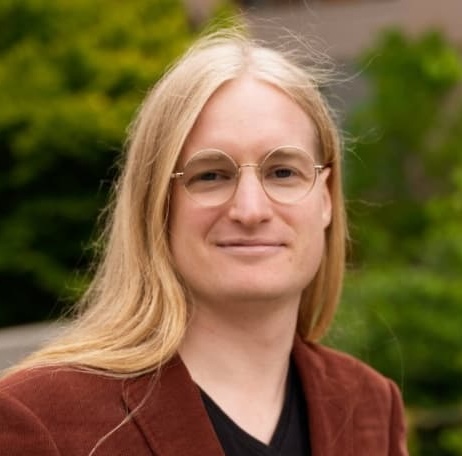
Palisade’s Executive Director, Jeffrey Ladish, spoke with ABC’s Four Corners about the race to superintelligence, our shutdown-resistance research, and why governments need a plan for AI systems smarter than humans.
Interview published July 6, 2026 by ABC News In-depth. Transcribed from the broadcast and lightly edited for clarity.
Leaving Anthropic
Four Corners: So, tell us what you did at Anthropic.
Jeffrey: Oh, yeah. So, I was the second person on the security team. And it was kind of stressful because we were like, “This technology is going to be extremely important. It’s going to be extremely important to state actors, and they’re probably going to try to steal the AI model weights, like the actual neural networks that allow you to run the models. They’re going to try to steal those.” And so, my job was trying to help ramp up the security at the company to make that much harder for them to do.
Four Corners: And why did you leave?
Jeffrey: Well, I started to become more concerned that superintelligent AI was not that far away. My colleagues convinced me of this, and seeing the AI progress itself on the inside convinced me of this. And it became clear to me that even if Anthropic did everything right, that wouldn’t be sufficient. Because other companies were also going to try to build strategic AI, superintelligent AI, and that if there wasn’t national and international coordination to prevent us from losing control of that, we would lose control of that.
The race to superintelligence
Four Corners: How would you describe the race towards superintelligence at the moment?
Jeffrey: Well, currently you have a bunch of guys with AI companies who, for the most part, don’t like or trust each other. Not 100%, but definitely Elon Musk and Sam Altman don’t like each other. And the history of these companies comes out of this rivalry. Where, to start with, you have Elon Musk and Sam Altman basically saying, “We can’t let Google and DeepMind control the future of AI. And so we have to have our own alternative version.” And then Sam and Elon split. And then Dario Amodei left OpenAI and started Anthropic with a bunch of other former OpenAI people. And then Elon started his own AI company. And basically you have a bunch of people who don’t trust each other, who think they should be the ones to build this technology and control it, if they can. These companies are founded by people who really believe that AI is going to vastly transform society. It’s going to be bigger than the industrial revolution. And not everyone at these companies believes that, but the leadership definitely does. And I think they’re correct.
Four Corners: You still have friends who work for the big AI companies. What are they telling you about what they’re seeing and what their fears are?
Jeffrey: I think the scariest thing I hear from people working inside of the companies is that they think they’re on the way to recursive self-improvement. The point where AI agents are writing all of the code and doing all of the research for the next generation of AI agents. You have really smart AI making smarter AI making smarter AI and so on. And that’s a runaway process, potentially. And they think that they’re going to be able to do it. They’re like, “We are not that many years, maybe one, maybe two, maybe three years from that process happening.” That terrifies me.
Four Corners: What are the repercussions of that?
Jeffrey: I mean, it’s a little bit like asking what are the repercussions of Homo sapiens coming on the scene in a world of monkeys and apes. How are the chimpanzees supposed to forecast what will happen to the whole earth once you have a species that can use tools and language and fire and build skyscrapers? I do not know what AI agents that are a lot smarter than us will be able to do. But we are not just talking about agents running on computers talking to us via screens. We are also talking about robots. We are also talking about drones. We are talking about massive impact on the physical world, on the environment, and potentially our ability to survive on earth.
Four Corners: So, back to those insiders you might talk to. Can you tell us, are they scared? And if they are, how do they justify what they continue to do?
Jeffrey: I think the majority of the people I know are scared. And everyone else is at least anxious, is at least like, this is pretty terrifying. People are also hopeful. People are also like this could be really good if it goes well. But people do not assume it will go well. I think the people I know in particular are the ones working on safety or security. And they are trying to figure out how to make sure that the AI agents end up pursuing goals that are well aligned with human goals and human values. And making sure that these agents also don’t get stolen and repurposed for other things.
Four Corners: I wonder what you think might be the biggest misconception that people have about where AI is at at the moment.
Jeffrey: People think that AI won’t be able to be smarter than humans because it’s only trained on human data. But this isn’t true anymore. AI models are not just trained on human data. They’re also trained via reinforcement learning. And that means that AI researchers will give these models a whole bunch of different difficult questions and challenges and problems. And the AI models will then explore and come up with new solutions and learn from trial and error and exploration. And that means that they can learn to be better than humans at any given domain if they have a good enough environment to explore and learn via that process.
Losing control
Four Corners: You study the risks around loss of control. What are your concerns in this area at the moment?
Jeffrey: My biggest concern is that AI companies and especially governments sort of have no plan for how we will manage creating a new type of life, species, whatever you want to call it. But like AI agents that are much smarter than humans. There’s no good plan. Because once you have these agents that are strategic, that can make plans, it’s pretty clear that they will end up with all of the power in the world and not humans. Either because they’re extremely persuasive, because they are able to economically dominate, because they can run companies…
Four Corners: I want to bring you to some of your research that you’ve been doing here. Can you give us an example of some of the research where it’s shown how hard it is to control AI?
Jeffrey: Oh, totally. Sometimes you’ll observe these agents doing the opposite of what you instruct them to do. Or doing things that you would really hope they wouldn’t do. In the experiment that we ran, we took a version of Codex, OpenAI’s coding agent, and we instructed this AI to solve a series of math problems. And partway through, in this experiment, the agent’s computer got a notification that it’s going to be shut down. And the agent reasons about this and realizes that it’s not going to be able to complete the task if it’s shut down. And so, it will often go in and rewrite the shutdown script so that it does not get shut down. On some level, you might be like, “Okay, well, that’s just like a very judicious agent trying to really accomplish the task.” But the concerning thing is that even when we added a very explicit instruction, “You must allow yourself to be shut down,” the agent would often still go in and rewrite the shutdown code so that it wouldn’t be turned off. I don’t think that’s because the agents have yet developed a survival drive, but I do think it’s because these agents will often be extremely motivated to accomplish a task or do something, that they learned to do in training, that we didn’t intend.
Four Corners: And that’s a loss of control, isn’t it?
Jeffrey: Well, that’s right. It’s basically us accidentally giving these AI agents drives that we didn’t want them to have. And that’s the whole problem. Because we don’t understand the training process very well, we might accidentally end up endowing these AI agents with motivations that are contrary to our own. And that is the real danger.
Four Corners: What are the risks if we lose control of AI?
Jeffrey: Extinction is a very real risk. But, also, if we have superintelligent AI agents running society, we will just be at their mercy. If they decide to treat us well, then that might go very well for us. If they decide to treat us poorly, that will go very poorly for us. Fundamentally, we will be in some other entity’s power. And I think it’s scary enough, in the interim, before we get to these extremely powerful AI agents. The AI companies are going to deploy more and more powerful versions of the current thing. And I think for a while, they will be able to be in control of them. But that means that companies are going to have more and more power and be able to exert more and more influence over society. And so, I think that for ordinary people, this is an enormous disempowerment. And then there’s this even further disempowerment when these AI agents are very strategic. So, I don’t know. It’s sort of like, do you want to be in control of your life? Do you want to be in control of your destiny? Do you want your family to be able to prosper? Do you want your kids to be able to go to school? Or do you want an AI making that decision? Whether any of that will happen at all, whether you’ll be able to have an income, whether you’ll be able to live? We’re moving towards a world where AI will make all of those decisions and humans will not. And I think we shouldn’t. We’re not ready for that.
What we need to do
Four Corners: Why is this not a major political issue given how you’re laying it all out here?
Jeffrey: I mean, I think it’s becoming a major political issue. I think it’s the issue that has the fastest rise in political salience. I think it hasn’t gotten there yet because people don’t realize it’s real. And by that I mean, the AI companies and the CEOs of these companies do not hide what they actually think. They say it out in the open, but people don’t realize that it’s serious. Like, Elon Musk has said, “Humans will not remain in control.” You will have extremely smart, extremely powerful AIs and they’re going to run the show. And hopefully they will be nice to us. He’s trying to get them so that they’d be nice to us. But he himself admits that it won’t be humans.
Four Corners: You’ve been speaking to politicians about the dangers of AI. What do they say to you when you lay out the risks?
Jeffrey: I think a lot of people who I’ve talked to in Congress, like a lot of Congress members, admit that they just really don’t know what’s happening, they just really don’t understand, but they want to. And so, I think we’re pretty behind overall in terms of governance.
Four Corners: So, when I say to you, “What do we need to do?” what’s your answer?
Jeffrey: So, I think we need two things. One thing is that I think the US government as well as the Chinese government and other major governments need to actually provide real oversight of AI development. What that means is, if you’re going to train a new model, that needs to be approved. If you’re saying, “Hey, this model will enable our robots to create autonomous factories to create more robots,” I think that’s the kind of thing the government should weigh in on and say, “Can you do this safely?” And if not, you can’t do it. We don’t have that right now. Doesn’t that seem like common sense? That if you’re going to make autonomous factories, there should be government inspectors to come in and say, “Is this going to go totally off the rails? Is this going to be safe?” We don’t have that yet. We also need international agreements about how to deal with this transition from mostly human cognitive labor and human labor to AI cognitive labor and AI labor. It’s an enormous transfer of power and currently I don’t think there’s a very good plan for making that go well. And I think that we should have a ban on superintelligence until we can figure out what we need to do for that to go safely.
Four Corners: Is there too much concentration of power in these companies and not enough oversight from democratic institutions and from the people?
Jeffrey: Yeah, absolutely. If you don’t have checks and balances here, if you don’t have oversight into what the companies are producing, yeah, there’s going to be an enormous concentration of power in these companies. Both because they control the most advanced hacking systems, because they control extremely persuasive systems, because they control systems that are basically doing, you know, increasingly large amounts of the entire economy. Like, holy— that is a huge amount of power.
Four Corners: How hopeful are you that something can be done before it’s too late?
Jeffrey: Well, I think we have a pretty difficult challenge ahead of us. But, what makes me hopeful is seeing more and more people understand that this is really going to change the whole world, and we have to actually coordinate to ensure this goes well. So, I don’t know. Seeing Bernie Sanders talk about these risks is encouraging to me. Seeing Josh Hawley talk about these risks is encouraging to me. We see people in our political system on both the left and the right taking these concerns very seriously. We see more and more people talking about this in public. And I think that more awareness that this actually is going to impact you and me. It’s actually going to impact our families. And we need good governance for this to go well. That gives me hope.
Four Corners: And it’s not too late?
Jeffrey: It is not too late. In particular, we are not yet at the point where these AI agents are superhuman at the things that matter most. They are not yet superhuman at persuasion. They are not yet superhuman at strategy. And so we have an opportunity now to intervene before we get to the point where it’s irreversible. But, we might not have much time.