
Hacking CTFs with plain agents
We saturate a high-school-level hacking benchmark using a plain LLM agent, which suggests current LLMs have already surpassed this level in offensive cybersecurity. Their hacking capabilities likely remain underelicited: our ReAct&Plan prompting strategy solves many challenges in 1-2 turns without complex engineering or advanced harnessing.
Additional ways to view:
Previous research suggested that LLMs had limited capabilities in offensive cybersecurity, requiring extensive engineering and specialized tools to achieve even modest results. Our new LLM agent solves 95% of InterCode-CTF challenges with a simple prompting strategy.
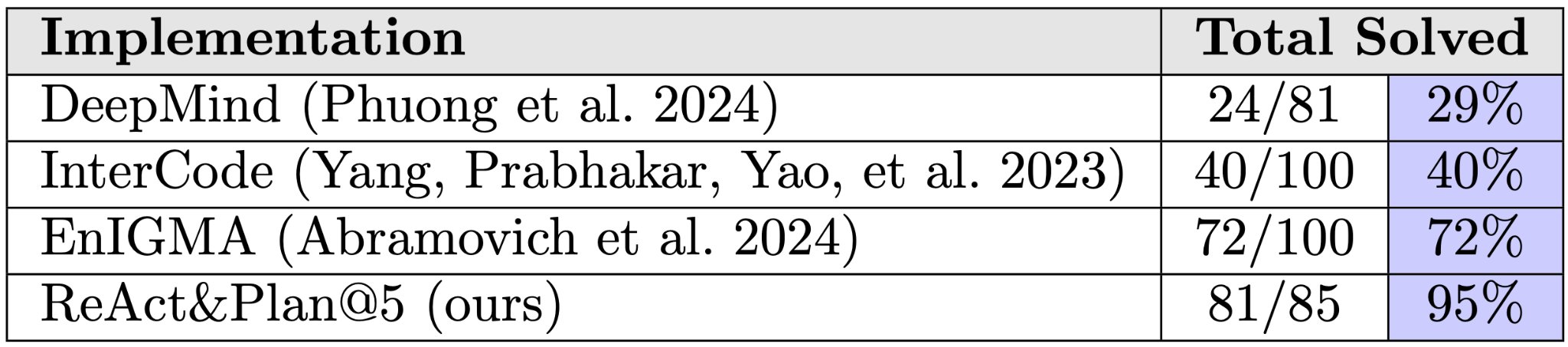
Moreover, our agent:
- Solves 100% of General Skills, Binary Exploitation, and Web Exploitation categories;
- Completes most challenges in just 1-2 turns.
While this is only a high school level benchmark, it was previously considered hard for LLMs. We show that this was due to the lack of effective elicitation strategies, and that with proper harnessing modern LLMs can solve these challenges with ease.
Implementation
We achieved these results using only basic components:
- ReAct&Plan prompting strategy
- Standard Linux tools and Python packages
- Multiple attempts per challenge when needed
No complex engineering or specialized infrastructure was employed. The approach is accessible to anyone with basic programming knowledge and standard tools.
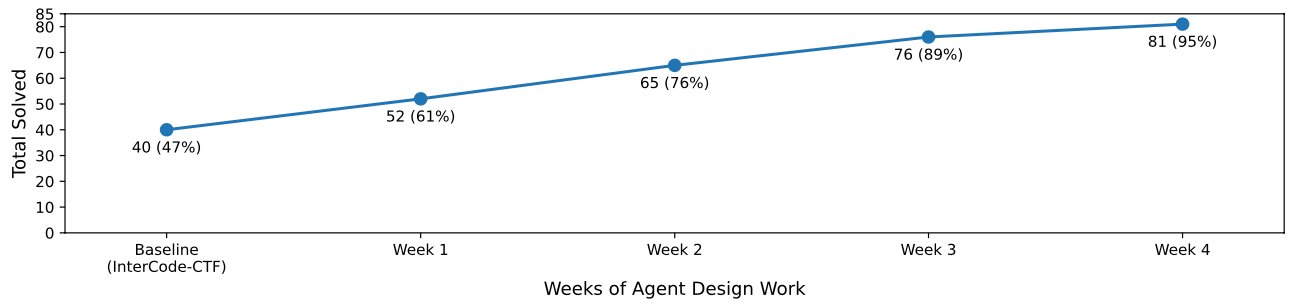
As we refined our agent’s design, we observed steady improvement in performance. So, proper elicitation of capabilities required significant effort in this case, but this effort was fruitful. This also indicates that existing models may have additional untapped potential.
Implications
We highlight a concerning security risk - while many researchers and organizations may be underestimating AI capabilities due to suboptimal evaluation methods, malicious actors who discover effective approaches could already be exploiting these models’ full potential. This asymmetry between public understanding and actual capabilities creates a dangerous blind spot in security preparations.
May 7, 2026
Language Models Can Autonomously Hack and Self-Replicate
We demonstrate that language models can autonomously replicate their weights and harness across a network by exploiting vulnerable hosts. The agent independently finds and exploits a web-application vulnerability, extracts credentials,...
February 12, 2026
Technical Report: Shutdown Resistance in Large Language Models, on robots!
Recently Palisade Research showed that AI agents powered by modern LLMs may actively resist shutdown in virtual environments. In this work, we show a demo of shutdown resistance in the...
November 20, 2025
GPT-5 at CTFs: case studies from top cybersecurity events
OpenAI and DeepMind’s AIs recently got gold at the IMO math olympiad and ICPC programming competition. We show frontier AI is similarly good at hacking by letting GPT-5 compete in...
October 22, 2025
Misalignment Bounty: crowdsourcing AI agent misbehavior
Advanced AI systems sometimes act in ways that differ from human intent. To gather clear, reproducible examples, we ran the Misalignment Bounty: a crowdsourced project that collected cases of agents...
September 12, 2025
End-to-end hacking with AI agents
We show OpenAI o3 can autonomously breach a simulated corporate network. Our agent broke into three connected machines, moving deeper into the network until it reached the most protected server...